

Have you ever felt stressed and noticed a part of your body go frozen or sore? Your body signals how your mental health is doing, since the two are parts of one system.
Somatic therapy works with that connection directly. It settles the nervous system through breath, movement, and attention to physical sensation.
In this blog, we cover 7 somatic therapy exercises that you can practice to regulate your nervous system:
1. Cyclic Sighing
Two short inhales reinflate the small air sacs in your lungs that collapse during shallow, stressed breathing. The long exhale that follows clears more carbon dioxide and slows your heart rate through the vagus nerve.
Try this:
Inhale through your nose
Take a second shorter inhale to top up
Exhale slowly through your mouth
Repeat for 5 minutes
Practise 5 minutes a day rather than only when you are stressed, since the effect builds the longer you keep it up. A single round of 3 to 5 breaths slows your heart rate within about 15 seconds, so it works at your desk or in a hallway.
2. Orienting
An activated nervous system keeps scanning for danger, sometimes months after the threat has passed. The amygdala stores threat without a time stamp attached, so your body responds to the memory the way it responded to the original event.
Orienting breaks that loop by showing your eyes what is in front of you right now. Looking around slowly and on purpose shifts you from scanning for threat to plain curiosity, which tells your body the room is safe.
Try this:
Let your eyes move slowly around the room
Turn your head to follow them
Rest on whatever draws your attention
Name a few objects out loud
A sigh or yawn often arrives partway through. That shift is the nervous system registering safety.
3. Pendulation
Peter Levine built pendulation on the observation that the nervous system moves naturally between contraction and expansion. If you stay inside distress, it overwhelms your capacity to process it. If you avoid it entirely, it sits there unprocessed.
Small doses, back and forth, widen how much you can tolerate before the system shuts down. Somatic Experiencing calls this titration.
Try this:
Find where the tension sits in your body
Find a place that feels neutral or settled
Move your attention between the two
Stay 20 to 30 seconds in each
Finish on the settled place
Always end on the neutral spot. This back-and-forth is why somatic work builds capacity without flooding you.
4. Trauma-Sensitive Yoga
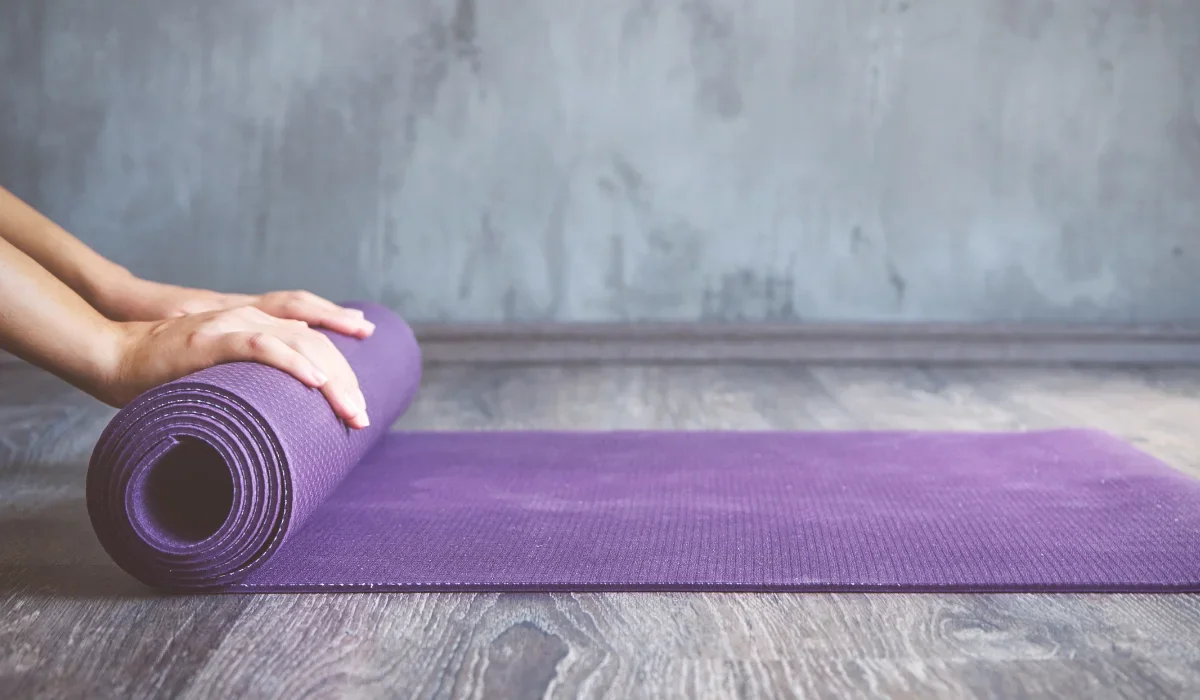
PTSD dulls interoception, your sense of what is happening inside your body. Trauma-sensitive yoga rebuilds that signal through choice-based language, no hands-on adjustments, and attention on internal sensation rather than correct form.
A randomised controlled trial led by Bessel van der Kolk followed 64 women with chronic, treatment-resistant PTSD. After 10 weeks, 52% of the yoga group no longer met diagnostic criteria, compared with 21% of the control group.
Try this:
Move through poses slowly and hold them
Notice sensation rather than appearance
Change or stop any posture at any point
Practise 1 to 2 times a week
Look for instructors trained specifically in trauma-informed yoga.
5. Bilateral Tapping
Lucina Artigas came up with the butterfly hug in 1998, while helping survivors of Hurricane Pauline in Mexico. Tapping from side to side works much the same way EMDR does. Your brain can only hold so much at once, so the steady rhythm takes up space while you think about something painful, and the memory loses some of its sting.
The steady side-to-side rhythm also mirrors the pace of being rocked, which the nervous system reads as containment rather than threat.
Try this:
Cross your arms over your chest
Rest your hands below your collarbones
Tap slowly, alternating left and right
Continue for 1 to 2 minutes
Keep the pace slow, around 1 tap per second, since faster tapping raises arousal rather than settling it. Stop once your breathing evens out, usually within 1 to 2 minutes.
6. Voo Breathing
Voo breathing is a sounded exhale developed by Peter Levine, the founder of Somatic Experiencing. The vagus nerve runs down through the throat and chest and branches into the larynx, so a low sustained sound vibrates the tissue surrounding it.
That vibration, combined with an exhale far longer than your inhale, stimulates the vagus nerve directly and brings your heart rate down.
Try this:
Inhale normally through your nose
Make a low extended "voo" sound as you exhale
Let the sound vibrate in your chest
Pause before the next breath
Repeat 5 to 8 times
Keep the pitch low and the volume moderate, since the vibration does the work rather than the loudness. Most people feel it settle in the chest and belly by the third or fourth round.
7. The Basic Exercise
The Basic Exercise comes from Stanley Rosenberg, a craniosacral therapist who built a set of practices around polyvagal theory. It targets the suboccipital muscles at the base of the skull, which tighten under sustained stress and restrict movement between the top two vertebrae.
The vagus nerve leaves the skull right beside those vertebrae. When you loosen the muscles around them, the nerve is meant to work properly again. Therapists use this one widely, though it has not been put through trials the way the first few on this list have.
Try this:
Lie down or sit with your hands behind your head
Keep your head still and move only your eyes to one side
Hold until a sigh, swallow, or yawn arrives
Bring your eyes back to centre
Repeat on the other side
The sigh or swallow signals the shift and usually arrives within 30 to 60 seconds.
Somatic Therapy in Brampton
Sometimes the body holds onto what the mind has already moved past.
Here and Now Therapy offers somatic therapy for anxiety, trauma, and chronic stress. Our therapists use evidence-based approaches and an awareness-based lens to create a compassionate, judgement-free space, held with cultural context that South Asian clients never have to explain.
In-person sessions take place in Brampton, with virtual therapy available across Ontario.
Book a free consultation today.