

6 Powerful ACT Therapy Exercises for Anxiety
Anxiety can quickly turn conversations, deadlines, and uncertainty into cycles of overthinking, tension, and avoidance. Many people wait to feel calm before taking action, but this often keeps anxiety going.
Acceptance and Commitment Therapy (ACT) takes a different approach. Instead of trying to eliminate anxious thoughts completely, it helps people change how they respond to them. The goal is to build psychological flexibility while continuing to move toward a meaningful and values driven life.
Here are 6 powerful ACT therapy exercises to calm down and feel less anxious:
1. The Expansion Exercise
When anxiety shows up, many people automatically tense their bodies or mentally fight the feeling. The Expansion Exercise teaches the opposite approach by helping create space for the emotion instead of resisting it.
Try this:
Pause and notice where the anxiety sits in the body
Look for sensations like chest tightness or shoulder tension
Take a slower breath
Imagine softening on a pillow instead of pushing it away
While it may not resolve the issue you're thinking about, it will help you loosen up your shoulders and breathe calmly.
2. Leaves on a Stream
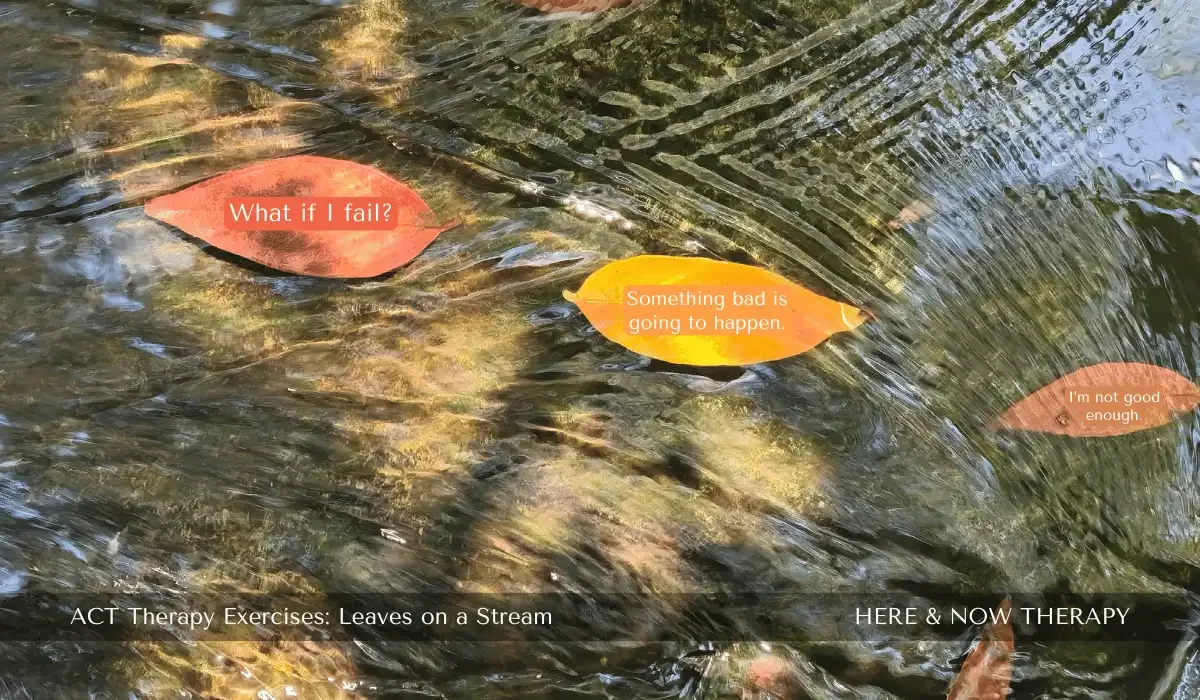
Anxious minds often treat thoughts like facts, causing worries to spiral quickly. The Leaves on a Stream exercise helps create distance from those thoughts instead of getting pulled into them.
Imagine a stream with leaves floating on the water. Each time a thought appears, place it on a leaf and watch it drift away. The thought could be:
“What if I fail?”
“Something bad is going to happen.”
“I’m not good enough.”
This exercise encourages observation instead of reaction. Over time, it can make anxious thoughts feel less overwhelming and easier to sit with.
3. The 5-4-3-2-1 Grounding Exercise
Anxiety often pulls attention into imagined future scenarios. Grounding Exercise helps bring focus back to the present moment using your senses:
5 things you can see
4 things you can feel
3 things you can hear
2 things you can smell
1 thing you can taste
Every time you feel panic, overstimulation, or running thoughts distract yourself with this exercise.
If you cannot get yourself to distract, feel your feet on the ground and take one slow breath.
4. The Chessboard Metaphor (Observer Exercise)
People often become completely identified with anxious thoughts, like:
“I am anxious.”
“I am failing.”
“I can’t do this.”
The Chessboard Metaphor teaches that thoughts and emotions are experiences you have, not who you are. Imagine a chessboard where black and white pieces represent difficult and pleasant thoughts battling each other.
ACT suggests that you are not the pieces; you are the chessboard holding it all. This exercise creates perspective during emotional overwhelm.
5. Values Clarification Exercise
Anxiety can slowly shrink life as fear becomes the main decision maker. The Values Clarification Exercise helps reconnect you to what truly matters.
Reflect on:
relationships
parenting
work
faith
health
Focus on qualities rather than achievements, such as being:
loving
honest
courageous
present
patient
6. The Willingness and Action Exercise
Many people wait to feel confident before taking action. ACT encourages meaningful action even when anxiety is present.
Start with one small step:
making the phone call
attending the event
speaking honestly
stepping outside
Start with one exercise that feels manageable, practice it regularly, and return later to explore other techniques as your confidence gradually builds.
Get Matched with an ACT Therapist in Brampton
ACT works best when it becomes a daily practice rather than a crisis response. The more these tools are used in small, ordinary moments, the less power anxiety holds in the bigger ones.
Here and Now Therapy offers therapy and support for anxiety, overthinking, avoidance, and stress and depression. Our therapists use an awareness-based lens to create a compassionate, judgement-free space where you can begin to understand what drives your anxiety, not just manage it in the moment.
In-person sessions take place in Brampton, with virtual therapy available across Ontario.
Book a consultation and we will match you with a therapist who best fits your needs.